


Discover the skin conditions you can’t see in the mirror with FOCUSKIN, PIE’s AI skin analyzer.
Although you may sometimes notice that your skin feels dry or that your pores look more visible when you look in the mirror, it is not easy to understand the exact condition of your skin.
Even when skin looks similar on the surface, its condition differs from person to person. What appears to be dry skin may mainly be caused by a lack of moisture, or it may actually be combination skin with an imbalance between sebum and moisture. Concerns such as pigmentation, redness, and porphyrins are also difficult to examine closely with an ordinary mirror or smartphone camera.
Then what can we learn by photographing and analyzing the skin under different light sources? In this article, we will look at FOCUSKIN’s skin analysis parameters and imaging principles, as well as how the actual analysis results can be used.
What Can FOCUSKIN Analyze?
FOCUSKIN does not assess the skin from just one ordinary facial photograph. It captures skin images under different conditions using a 20-megapixel digital camera, SunLike LEDs, polarization filters, and 385 nm UV LEDs.
The main analysis parameters include:
- Skin type
- Pores
- Wrinkles
- Elasticity
- Polarized pigmentation
- UV pigmentation
- Skin gloss
- Skin tone
- Redness
- Sebum
- Porphyrin
- Moisture
- Radiance
Rather than presenting the entire face as a single score, the results are divided into major areas such as the forehead, nose, and both cheeks. Even on the same person, the forehead and nose may have more sebum while the cheeks may lack moisture, so it is important to review the results by facial area.
The results can also be compared with average data for the same age group, allowing users to see where their current skin condition stands in relation to their peers.
Why Do Skin Analyzers Use Different Types of Light?
The information visible in the skin changes depending on the light source and imaging method.
The face seen in a mirror or ordinary camera image contains a mixture of light reflected from the skin surface and light scattered within the skin. As a result, shine, surface contours, pigmentation, and vascular information may overlap.
FOCUSKIN separates this information using normal light, cross-polarized light, parallel-polarized light, and 385 nm UV light.
1. Normal Light: Checking Natural Skin Color and Overall Skin Condition

Normal-light images are the closest to how we usually see the skin with our eyes.
FOCUSKIN uses SunLike LEDs to reproduce colors similar to natural light. Normal-light images are used to examine skin tone, pores, overall facial brightness, and the general condition of the skin.
Natural color reproduction is extremely important in skin analysis. If skin color and brightness change with every capture, the reliability of the analysis and before-and-after comparisons may also decline.
2. Cross-Polarized Light: How Surface Reflections Are Reduced
Cross-polarized imaging places the polarization direction of the light source at a right angle to that of the polarization filter in front of the camera.
Light reflected directly from the skin surface largely retains its original polarization direction. When a polarization filter with the opposite orientation is placed in front of the camera, most of this surface reflection is blocked.
By contrast, light that enters the skin and is scattered multiple times changes its polarization direction and can partly pass through the filter. This reduces surface glare and makes pigmentation, redness, and vascular color changes relatively clearer.
FOCUSKIN uses cross-polarized images for analyses such as pigmentation and redness.
3. Parallel-Polarized Light: Examining Skin Texture and Surface Contours
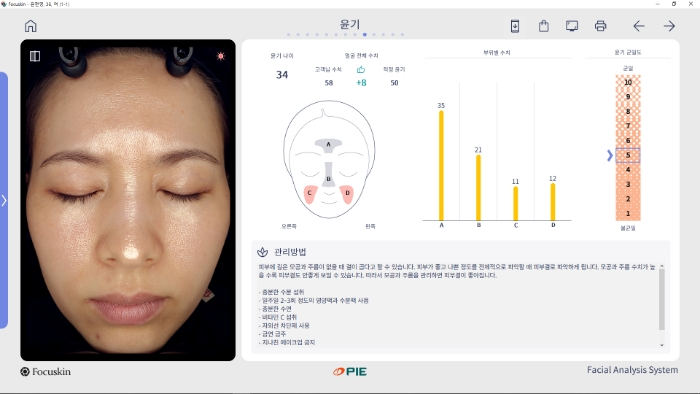
In parallel-polarized imaging, the polarization directions of the illumination and the camera filter are aligned.
This allows light reflected from the skin surface to enter the camera, relatively emphasizing skin texture, fine contours, wrinkles, and surface gloss. FOCUSKIN uses parallel-polarized images for analyses such as wrinkles and skin texture.
4. 385 nm UV Light: Revealing Pigmentation and Porphyrins That Are Otherwise Difficult to See
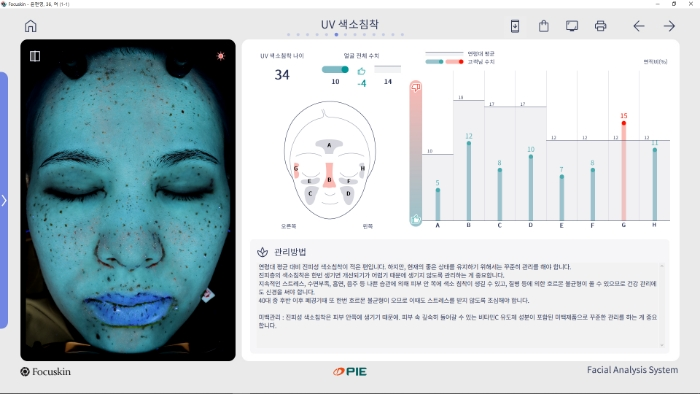
FOCUSKIN illuminates the skin with 385 nm UVA light and captures differences in fluorescence and light absorption produced by the skin.
Areas with more melanin may absorb relatively more UV light and therefore appear darker. Certain porphyrins associated with sebum react to UV light and appear as orange or reddish fluorescence.
This makes it possible to examine information that may not be clearly visible in normal-light images, including:
- Distribution of UV pigmentation
- Distribution of sebum
- Distribution and ratio of porphyrins
- Sunscreen or cosmetic residue
- Cleansing condition of the skin surface
Porphyrins are fluorescent substances that can be produced during the metabolic processes of skin microorganisms associated with sebum. Porphyrin results should therefore not be interpreted as a definitive diagnosis of acne, but as reference information for assessing sebum condition and providing skin-care consultations.
How Does AI Analyze the Skin?
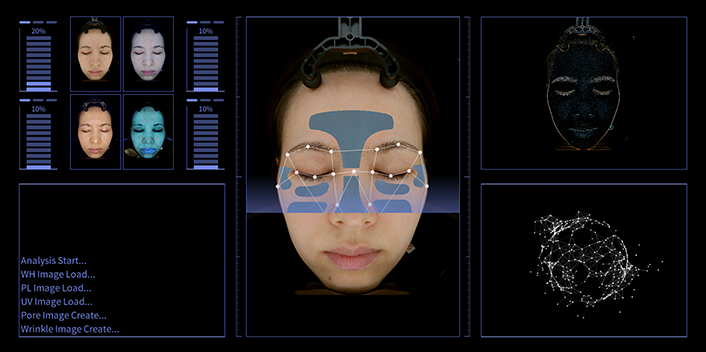
After imaging is completed, FOCUSKIN automatically detects the face and identifies the areas to be analyzed. It then analyzes the number of pixels, area, brightness, size, shape, and distribution associated with each skin concern in the captured images.
For example, pigmentation analysis does not simply count spots; it also considers their size, intensity, and distribution area. Pore analysis likewise uses image information such as not only the visible number of pores but also their size and depth.
One advantage of AI skin analysis is that images can be processed according to consistent criteria rather than relying solely on visual assessment by a person.
For accurate before-and-after comparisons, however, a consistent imaging environment is just as important as the AI algorithm. FOCUSKIN is designed to maintain consistent repeat-capture conditions through a hood that blocks external light, facial-position correction, and technologies that maintain brightness and color.
Benefits of Using FOCUSKIN
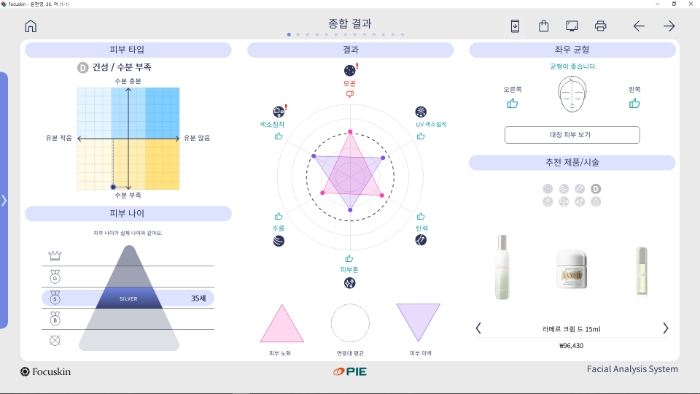
One of the most impressive benefits is the ability to view skin concerns that previously felt vague through images and numerical data.
Skin that simply looks dull in the mirror can be examined to determine whether the appearance is related to skin tone, pigmentation, or color changes caused by redness. When the skin feels oily, users can also check whether sebum is actually widely distributed or whether the porphyrin ratio is high.
Based on the analysis results, users can receive recommendations for cosmetics or skin-care programs suited to their skin condition. A follow-up capture after a set period also makes it possible to compare results and observe changes in the skin.
However, FOCUSKIN results are not medical test results for diagnosing disease. They are intended to support personalized skin care and cosmetic consultations.
Where Can I Receive a FOCUSKIN Skin Analysis?

FOCUSKIN is installed in a variety of skin-consultation settings, including aesthetic centers, cosmetic stores, and beauty-brand stores.
Search for “FOCUSKIN” on Instagram or Naver Blog to find a location where you can receive a consultation.
Installation locations and experience programs may change, and reservations may be required depending on the store. It is therefore recommended to contact the location before visiting and confirm whether FOCUSKIN skin analysis is available.
Good Skin Care Begins with Understanding Your Skin Accurately
Rather than simply following popular cosmetic recommendations, it is important to first assess your own skin condition objectively.
FOCUSKIN uses AI to analyze skin images captured under normal light, cross-polarized light, parallel-polarized light, and 385 nm UV light, presenting information about pores, wrinkles, pigmentation, redness, sebum, porphyrins, moisture, and other skin conditions.
If you want to examine skin concerns that are difficult to understand from a mirror alone through images and data, an AI skin analysis can be a useful way to begin by checking your current skin condition.